Showing posts with label muscle building. Show all posts

Monday, September 14, 2015

Mastering the Basic Fitness Moves - Part Two - Lunges

In part two of Mastering the Basics we are going to discuss another great lower body exercise; lunges. Lunges can be varied in so many ways to target so many lower body areas that if you are not doing them in your workout, you are doing yourself a great disservice.

Lunges are a lower body exercise that primarily works the glutes, hamstrings, and quadriceps. As I said, there are a number of variations that can be performed and depending on the type performed these muscles will be worked to varying degrees and some secondary muscles including the hip adductors and abductors will contribute as stabilizers. Adding to their versatility, lunges can be performed with almost every piece of resistance equipment in the gym including dumbbells, barbells, elastic bands, and kettle bells.


When doing lunges for the first time with a novice client, I always start with static lunges.  I also do not use weight initially as lunges require good balance and performing them with weight before you can master the core movement pattern can lead to people flinging dumbbells around as they struggle to stay upright.

Lunges can be performed statically or dynamically (AKA walking). A static lunge is one that is performed by stepping and then returning back to the starting position after each rep. Static lunges can be done forwards, backwards, or laterally (sideways). A walking lunge is one in which the person, rather than stepping back to the original starting position, propels themselves in the desired direction. Walking lunges can also be performed forwards, backwards, and laterally.  

FORWARD LUNGES
If this is the first time you are performing a lunge feel free to use a chair or some other stable surface to place your hand on. This will allow you to maintain balance and safety and also allow you to focus on the core movement pattern itself. To perform a static lunge you will start with your feet together. Take a LARGE step forward with one leg placing it firmly onto the ground. Poor step length is a common area where people mess up. Oftentimes the step is too short causing the knee to travel over the toes and placing too much stress on the patella which can be painful and possibly cause injury if performed like this consistently.

With the foot planted firmly, bend the front knee to lower the body to the ground. The back leg can be bent as you lower to the ground, but I instruct my clients to keep it as straight as possible in order to get a stretch on the hip flexor muscle group. Both head and chest should be as upright as possible though the entire movement; DO NOT allow your trunk to lean forward. This is another common mistake. The descent of the lunge should be controlled, do not go down so fast or so far that the back knee strikes the ground. This is dangerous and can cause injury.


After you have lowered yourself until the front thigh is parallel with the ground, push forcefully off of the front leg to propel yourself backward to the starting position. You can repeat another rep with the same leg, or you can alternate legs. I choose to have my clients alternate when performing the movement as it gives each leg a mini rest before it has to perform the next rep and allows more quality movements to be performed.  

BACKWARD LUNGES
A backward lunge, in my opinion, is much easier to perform statically versus its forward counterpart.  The upper body mechanics of the backward lunge remain the same, keeping the head and chest upright without leaning forward at the waist. Take a LARGE step backwards, large enough to ensure that the front knee remains behind the toes. In a backwards lunge as you step back, only the toes will make contact with the ground, after they do you will want to bend the front knee, again until the thigh is parallel with the ground. Once the front thigh reaches parallel you will use the front leg to force yourself forward and up to the starting position. Again you can perform one leg at a time, or alternate.


LATERAL LUNGES
Lateral lunges are mechanically different from both the forward and backward variations. You still want to keep the head and chest as upright as you can, but there will be some bend at the waist as this will be needed to keep weight balanced and perform the movement correctly.  Starting with the feet together you will begin with a LARGE side step landing with the foot placed firmly on the floor (Some people feel that you should turn the front foot out slightly as you step, however I feel that it is more effective for the intended targeted muscles to leave the from toes facing forwards). Once stable you are going to bend the forward knee and push your butt back, it will somewhat resemble a hybrid between a lunge and a squat, again keep the knee behind the toes on the working side. Once you have bent the knee so that the working side thigh is parallel to the ground, push off forcefully with the working side leg to return back to the starting position. As with the other two variations, you may do all on one leg first or alternate.


WALKING LUNGES
Walking lunges, no matter what direction they are performed in, are mechanically the same to begin with as their static counterparts. They only differ in that instead of returning to the starting position after each rep, you will propel yourself in the desired direction prior to the next rep. It is interesting to note that although forward lunges are more difficult statically, backward lunges are more difficult dynamically. Lateral lunges become increasingly difficult when performing the walking variation. When doing walking lunges you may need to take what I call a stopping step in between each rep, meaning that when you return to upright position you will place both feet on the floor to maintain balance. Once your balance in improved you can opt to perform one rep progressing directly into the next one without a stop step at full upright.

Lunges are so versatile and can be performed in so many different ways it would be impossible to write a fully comprehensive manual, but I did try to touch on the three most common variations. Lunges are a great way to build the quads and buttock muscles and to give the lower body a nice lean look. They also are effective at helping to normalize strength between legs if you have a noticeably weak side. Start easy with lunges and work your way up. Also be honest about whether or not you are ready to try more complex or weighted versions. Do not try to progress until you have mastered the basic movement pattern. Until next time. - Aaron

Thursday, August 27, 2015

Mastering the Basic Fitness Moves - Part One - Squats

When I begin training a new client, one of the first things I teach them is how to perform the basic movements of exercise with safe and effective technique. These movements are the basis of most exercises in the gym and once mastered a client can be progressed to more complex and strenuous exercises that will help them continue to progress with minimal risk of injuring themselves. 

In this series of posts I will introduce what I believe to be 6 of the most basic and important exercises to master and build your weight training program around. Squats, Lunges, Deadlifts, Bench Presses, Rows, and Planks. We will discuss what muscles these movements work, proper technique of each, and how to modify them if needed.  

Squats

We will begin with squats because as many seasoned weightlifters will tell you, the squat is the "king of exercises". Squats are an almost complete body exercise that works the gluteus maximus, quadriceps, hamstrings, abdomen, back, leg adductors and abductors. 

Picture courtesy of nobrainermuscle.com

Some may say that squats can be bad for your back or knees, but in my experience I find that if performed correctly, squats can be an effective strengthener of these areas and actually be used as a tool to limit injury to these areas. The key however is to make sure you are performing squats correctly. All too often I see people, mostly men, performing squats in the gym with improper technique and way too much weight, in which case you will greatly increase your risk of knee, hip, and back injuries.

When teaching a client squats for the first time, I often use the Smith machine. A Smith machine is a piece of equipment at the gym that consists of a barbell that travels on a fixed path that will only allow vertical movements. My rationale for using this equipment to begin with is simple: a free weight barbell squat requires a lot of stabilization from the body and many new, and even some experienced exercisers, are not sufficiently strong or balanced to begin this way. By using the smith machine I limit the extraneous stabilization needs of the squat which will allow my client to focus on the core movement pattern and utilize proper form. 

Picture courtesy of beaucoupfit.com

Once a client is able to perform the primary movement consistently with proper form, only then do I move them to a free weight version of the exercise. It is important to note that some people are able to perform consistent safe form with only a minimal amount of time on the smith machine, others, may require more time performing this variation. All that matters before progressing is that proper form is achieved. Do not rush into a free weight version of squats before you are ready as the risk of injury will be greatly increased.

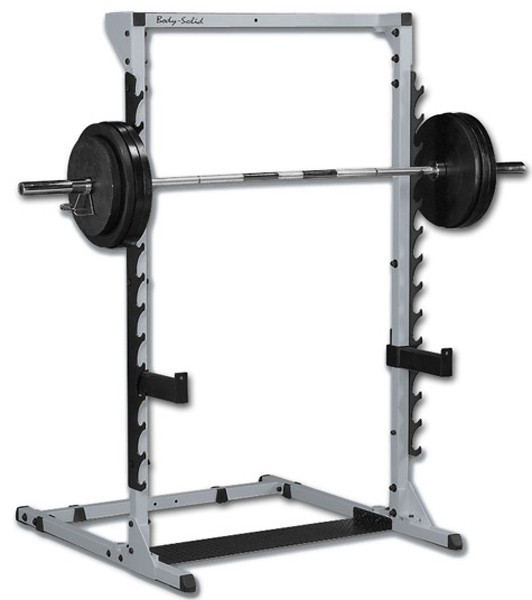
Once the movement pattern has been mastered and you are ready to begin free weight squats you will want to do so inside of a weight rack. Weight racks vary greatly (see examples below), but the main purpose of them is to allow you to step under the barbell, set your feet and body safely, accept the weight onto your body, back away from the rack, and then perform the squat. When you are finished you step forward to the rack and set the weight back down safely. 


Before performing free weight squats there are a few safety concerns we need to address. If it is your first time performing a free weight squat I urge you to have a qualified professional with you. They can ensure proper form, help spot you if things get out of control, and give you instruction on how to improve. Also when performing a free weight squat for the first time keep your weights low and focus on your form. Only progress your weight when you can do the movement with perfect form and light weight.

You are now ready to squat! Step under the weight and place it across the top portion of your back, NEVER across the neck. Some people find it uncomfortable to have a bar sitting across their back. Many gyms provide padding that you can put on the bar for comfort. Others opt for just a towel rolled around the bar. Whatever you choose, if anything, be aware that it can give the bar a slight unbalanced feeling and this will affect your lift. Place your hands wider than the width of your shoulders and grip the bar firmly. With the weight properly seated on your upper back/shoulders and a tight grip, push upwards to lift the weight off the rack. Be sure to keep your core contracted. To do this you want to suck your stomach in as though you are trying to pull your bellybutton in towards your spine. This will help stabilize your back and reduce risk of injury.

Back away from the rack just enough to allow you to descend unobstructed. Place you feet shoulder width apart and slightly toed outwards to about 45 degrees. When you descend into a squat you want to push your butt backwards as though you are trying to sit in a chair that is not there. You never want to go straight down as this will cause too much forward lean and stress on the back. Keep your head and torso upright, make sure your weight is focused into your heels, and that your knees sit equal to or just behind your toes. They should never travel forward of the toes as this can cause knee pain and injury. Be sure to breathe in as you descend into the squat.  

The ideal squat should go low enough that your thighs reach parallel with the floor meaning your butt will be just below parallel. There are many other variations that call for deeper squatting technique but these should be reserved only for experienced lifters who know how to perform them safely. Most people will be able to descend to parallel, however if you have a history of knee problems, or feel that you cannot get to parallel safely, go to just above parallel. 


Once you reach parallel position, or just above, begin to stand immediately as you exhale through pursed lips. DO NOT sit in the bottom position, nor should you bounce the weight at the bottom. When standing you want to drive the weight upwards, with most of the pressure through your heels. As you ascend you want to push your hips forward and back under you to attain a fully upright position. DO NOT lock out your knees at the top. Once at the top check that you contract your core again before beginning the next rep.  

Squats are an important move to master and the form is a basis of many other variation of the exercise that will allow you to work more specific parts of the body. Spend the time and effort in the gym to master them and you won’t be sorry. Stay tuned for the next exercise we will explore in this series: LUNGES. Until next time – Aaron

**Disclaimer: This guide is not meant to be a comprehensive review of squatting, nor is it meant to substitute for the real life guidance of a qualified personal trainer. It is for educational purposes only.  People vary greatly and so do their needs. There may be extenuating circumstances of your health that have not been accounted for in this article and only a qualified trainer can assist you with this in a one-on-one situation. Please exercise caution and safety and consult with your physician before undertaking any type of weight training regimen**

Thursday, August 13, 2015

Protein Intake; Why, How Much, How Often, and What Kind?

I generally try to derive some inspiration for these posts from my day-to-day interaction with my clients. Recently a client wanted some more in-depth explanation about protein supplementation and I felt that since I talk so much about it, a new post was warranted.

WHY IS IT IMPORTANT?

Protein is vital macronutrient that is important for growth and repair of tissues, maintenance of muscle structure, and the creation of several important enzymes (i.e. digestive enzymes) and hormones like insulin. Protein can also be used as a source of energy if need be. While proper protein intake is important for all people, it becomes even more vital to those engaging in a workout regimen due to their increased need for tissue repair and growth. When you engage in resistance training you are basically causing small tears in your muscle fibers. As these tears repair themselves they do it in a way that the new fibers are thicker and stronger than before. Protein aids in this repair and helps improve muscle recovery.

HOW MUCH SHOULD I GET?

The Recommended Daily Allowance (RDA) for adults with respect to protein is 0.8 g/kg of body weight, however when participating in a weight training program those needs are increased. The National Strength and Conditioning Association recommends 1.5 -2.0 g/kg of body weight per day. This range reflects the needs of those participating in a moderate strength program vs. those participating in a more vigorous program. *As a quick aside, if you are not sure how many kg you weigh, simply divide your body weight in pounds by 2.205*

When you participate in a workout program you must also be aware of proper pre and post-workout protein consumption in order to maximize your hard work in the gym. Pre-workout you want to get a good source of protein and carbohydrates. This will provide you with more energy as well as aid in minimizing muscle damage. Post-workout you want get that same combination of carbs and protein, but in a greater dose. Post workout protein consumption is even more vital that pre-workout. Immediately after you are done with your last set of exercise your muscles are very receptive to nutrient uptake, like little sponges waiting to absorb whatever is provided to them. It is at this time you need to take advantage of this 30-60 minute window by providing your muscles with a good source of protein as well as a simple carbohydrate source to also aid in replenishing glycogen stores to provide energy at your next workout. The post-workout consumption of this protein and carbohydrate mix is so important that Jeffrey Volek, Ph.D., R.D., a nutrition and exercise researcher at the University of Connecticut, says "If you're lifting weights and you don't consume protein, it's almost counterproductive".

HOW OFTEN SHOULD I CONSUME PROTEIN?

In addition to the amount of protein you consume per day, thought must also be given to when you are consuming it. Daily protein intake should be spread over the course of your three main meals as well as snacks so that you are in a state of protein synthesis all day. I find that most clients only have a high protein intake at dinner, but the issue with that is your body can only utilize so much protein at once. A study done at the University of Texas found that consuming 90 grams of protein at one meal provides the same benefit as eating 30 grams, thus effectively making the other 60 grams a waste.

As an example, if a 200lb man were to follow the 1.5 to 2.0 g/kg rule that would equal 136-181g of protein per day. Spread over the course of six meals, he would consume approximately 23-30g of protein per meal.

With respect to pre and post-workout protein and carbohydrate consumption research generally says you want to aim for at least a two-to-one ratio of carbs to protein. For example, consume 40 grams of carbs and 20 grams of protein.
And despite what you may have read out there, consuming increased amounts of protein will not damage your kidneys, in absence of any pre-existing conditions of course. "Taking in more than the recommended dose won't confer more benefit. It won't hurt you, but you'll just burn it off as extra energy," says Mark Tarnopolsky, M.D., Ph.D., who studies exercise and nutrition at McMaster University in Hamilton, Ontario

GOOD SOURCES OF PROTEIN

Proteins are made up of compounds called amino acids. There are 20 different amino acids classified as essential and non-essential. Essential amino acids are those that cannot be synthesized by the body and thus need to be consumed in your diet. A complete protein, mostly from animal sources, contain all the essential amino acids. An incomplete protein, mostly from plant-based sources, has only some of the essential amino acids, and thus needs to be combined with other incomplete proteins in order to consume all the essential amino acids. For example, while rice alone and beans alone are incomplete proteins, by combining them, you now have a complete protein source. Complete sources of proteins include things such as:
  • Meat
  • Fish
  • Dairy products (milk, yogurt, whey)
  • Eggs
Incomplete protein sources include:
  • Nuts & seeds
  • Legumes
  • Grains
  • Vegetables
Again going back to pre and post-workout protein consumption there are some things to be aware of. Due to the time needed for the body to digest and utilize whole-food sources of protein, these are often not optimal for your pre and post-workout meals. Instead, a better option is supplementing with protein powder. Whey protein powder, which is derived from milk, is a fast-digesting, high-quality protein that the body can utilize rapidly pre and post-workout. "It appears in your bloodstream 15 minutes after you consume it," Volek says. This is important when you remember that you only have a small window to supply your muscles with that much needed protein after your workouts for maximum benefit. 

I hope you have found this post insightful and can use it as a way to maximize you growth and potential in the gym. You put in the hard work and effort, so make sure you are following these guidelines to make it all worth it. Until next time! - Aaron

References:

1) http://www.menshealth.com/nutrition/protein-facts

2) http://healthyeating.sfgate.com/much-protein-required-weight-lifter-2062.html

3) http://www.builtlean.com/2012/10/03/complete-vs-incomplete-protein-sources/

4) http://www.active.com/nutrition/articles/get-enough-protein-post-workout